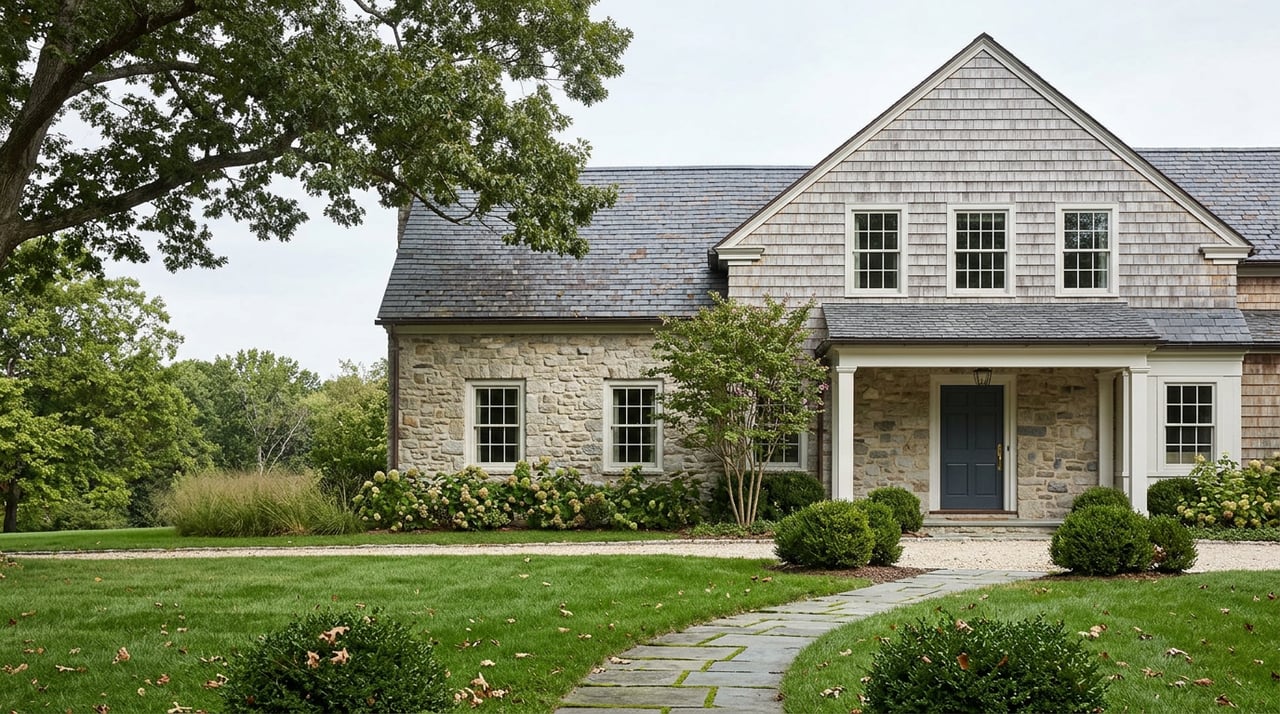
Gladwyne's Median Price Keeps Changing. The Real Story Is Underground.
Search "Gladwyne median home price" and you will get four different answers depending on which page loads first. One site says $1.2 million. Another says $2.35 million. A third splits the difference at $2.195 million. A fourth, updated for this September, lands at $1.704 million. These are not typos and they are not four different neighborhoods. They are four snapshots of the same roughly two-square-mile pocket of Lower Merion Township, taken at different moments, using different methods, and none of them agree.
The instinct is to assume the market itself is volatile, that Gladwyne prices are swinging wildly month to month the way a hot stock might. That is not quite what is happening. The real explanation has less to do with buyer demand and more to do with how few homes actually change hands here in any given month, and with a zoning decision written into Lower Merion's code decades ago for a reason that has nothing to do with prestige.
Here is what a buyer researching Gladwyne over the past sixteen months would have actually encountered:
| Snapshot | Figure cited | What it measures | Sales in that window |
|---|---|---|---|
| May 2025 | $1.2 million | Median closed sale price | 8 homes sold that month |
| June 2025 | $2,195,000 | Median closed sale price | 22 homes sold that month |
| Refreshed June 2026 | $2,350,000 | Estimated home value (not a closed sale) | 5 homes sold in the trailing 3 months |
| September 2026 | $1,704,000 | Median sale price ranking for zip 19035 | Not specified |
Two things jump out. First, the closed-sale figure itself moved by nearly $1 million between May and June of the same year, 2025. Second, the sales counts behind these numbers are tiny. Twenty-two closings is a busy month for Gladwyne. Five closings in an entire quarter, which is what one site reported for the period ending in June 2026, is not enough transactions to generate a stable median by any statistical standard.
That second point is easy to miss because "median" sounds authoritative. It implies a large, representative sample sorted in order. In a town of a few thousand homes where only a handful sell in any given stretch, one $4 million estate closing or one modest fixer-upper skewing the low end can move the reported median by hundreds of thousands of dollars. The number is not lying. It is just measuring something too thin to hold still.
If prestige and school access were the whole explanation for Gladwyne's pricing, you would expect the town to look like other high-demand Main Line pockets: a mix of lot sizes, some infill, maybe a townhouse development or two responding to demand. Gladwyne does not look like that, and the reason is written into Lower Merion Township's own planning history.
The township's land use documentation states plainly that most of the Gladwyne area is zoned for 90,000-square-foot lots, and it explains why:
"The lack of sewerage facilities throughout most of this area is the dominant factor that demands large-lot development."
Large lots in Gladwyne were never a lifestyle choice layered on top of an already-desirable location. They were the engineering answer to a practical problem. Without a public sewer main to tie into, each home needs enough land to support its own septic system, including a functioning drain field and the setback distances required to keep that system away from wells and neighboring properties. The same documentation notes that much of this land is also environmentally sensitive, which compounds the constraint rather than easing it.
That zoning decision is old. The infrastructure it responds to has not changed nearly as fast. Homes near Saunders Woods and along the Mill Creek corridor are still, today, largely dependent on the same private wastewater systems that shaped the original lot sizes.
This shows up in current listings, not just old planning memos. Two homes on Conshohocken State Road that came to market in 2026 both featured septic system replacements as headline upgrades: one advertised a system installed by Gray Brothers in 2019, the other a new septic system from 2023, listed right alongside roof and HVAC replacements as value-adding work.
That detail matters for anyone comparing Gladwyne to a denser, sewer-connected town. A buyer moving from a rowhome market where wastewater is someone else's utility problem needs to budget differently here. Septic pumping typically runs $290 to $700 per service. Repairs average around $1,775 nationally, though the range runs from $170 to $6,100 depending on what fails. A full system replacement averages closer to $7,350, with a range that stretches from $470 on the low end to $22,500 for a larger or more complex system. None of that shows up in a median sale price. All of it shows up in a home inspection.
The system also constrains what you can build. Before adding a bedroom or bathroom, most septic-served properties require a site evaluation and percolation test to confirm the existing system, or an expanded one, can handle the added load. That is not a bureaucratic formality. It is the difference between a straightforward renovation and a project that starts with a soil test and a conversation with the local health department before a contractor ever picks up a hammer.
Lower Merion Township is not uniformly built this way. The same land use record that explains Gladwyne's large lots also notes that community sewers, along with schools, churches, and retail, are concentrated in the southern portion of the township, closer to the major transportation corridors. Move toward that end of Lower Merion and you find smaller lots, denser subdivision patterns, and the infrastructure to support them.
Gladwyne sits at the other end of that spectrum by design, not by accident. It is also part of why the town has no condominium buildings at all. The closest thing to attached housing is a handful of small townhouse clusters on Black Rock Road, Wesleys Run, Hearthstone Lane, and Avignon Drive. Everything else is single-family, on a lot large enough to carry its own wastewater system. That is a structural ceiling on supply that no amount of buyer demand can lift, and it is a better explanation for why inventory stays thin than any narrative about prestige alone.
If you are comparing Gladwyne to other Main Line towns and a septic system is part of the picture, a few questions belong on your list before you get to the negotiating table:
That last question is where having a team that handles both the transaction and the construction side pays off. It is one thing to know a septic system needs work. It is another to have a realistic cost estimate and a contractor relationship in hand before you are three weeks into a renovation timeline.
Does a septic system affect financing? Lenders typically want confirmation that the system is functioning before closing, which usually means a recent inspection report rather than a full replacement unless something is actively failing.
Can I add a bedroom to a septic-served Gladwyne home? It depends on what the existing system is rated to handle. A percolation test and capacity review will tell you whether the current system supports the addition or whether an expansion is required first.
Why does Gladwyne have so little new construction compared to other Main Line towns? The same large-lot zoning that shaped the town's character also limits how much land is available to subdivide, and septic capacity adds another layer of constraint on top of the lot minimums.
If you are weighing a move to Gladwyne, or trying to figure out what a listing's septic disclosure actually means for your renovation plans, that is exactly the kind of ground-level detail worth talking through before you write an offer. The Collin + Colleen Whelan Team pairs Main Line brokerage experience with in-house construction and design work through Poplar, so the cost and timeline questions get answered before they become surprises. Schedule a consultation and bring your questions about the property, not just the price.

Contact us today to schedule a consultation and experience the personalized service and expertise that make The Collin + Colleen Whelan Team.
216 E Lancaster Ave Wayne PA 19087