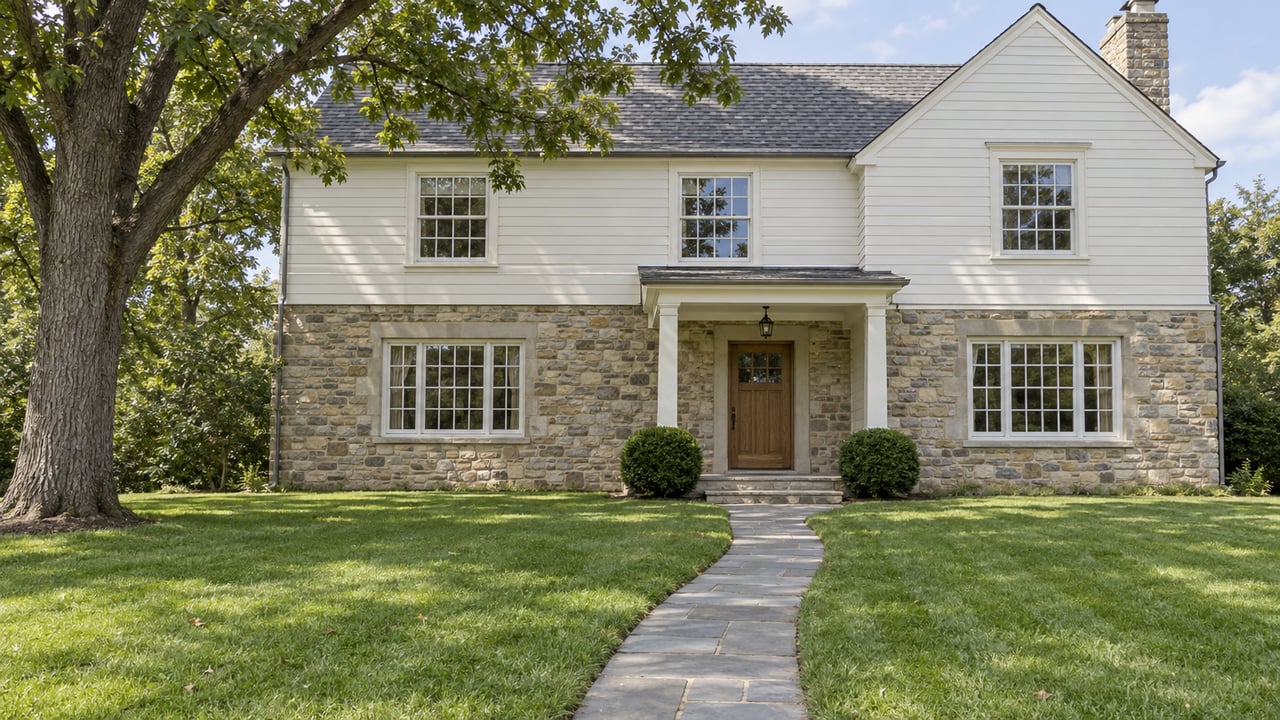
In Villanova, the Higher Tax Rate Isn't the One That Costs More
Picture two houses in Villanova, similar age, similar size, listed within a few weeks of each other. A buyer comparing them pulls up the tax history on both and sees a number that seems backward: the house with the lower millage rate carries the bigger annual bill. Nothing about the listing explains why. The zip code is the same. The school system sounds similar on paper. The only real difference is which side of Spring Mill Road the driveway sits on.
Villanova is not its own town. It has no borough council, no mayor, no separate tax office. The name covers zip code 19085, a stretch of the Main Line built around Villanova University, the SEPTA Paoli/Thorndale Regional Rail stop, and the Norristown High Speed Line. Most of it sits inside Radnor Township, in Delaware County. The northeastern edge, roughly the streets east of Spring Mill Road toward Gladwyne, sits inside Lower Merion Township, in Montgomery County. Two different counties, two different school systems, two different tax offices, all answering to the same mail carrier.
The heart of Villanova sits where Lancaster Pike crosses Spring Mill Road, home to the post office that serves 19085, an office building, and a small commercial cluster that includes Wilmington Trust's Pennsylvania headquarters and a Royal Bank of Pennsylvania office. That intersection reads as one place. The manor houses on Spring Mill Road, Mt. Pleasant Road, Ithan Avenue, and the lanes off County Line Road read as one architectural era, stone and brick estates built between the 1900s and the 1930s on lots that run two, five, or ten acres. None of that geography tells you which township collects your tax bill. Only the parcel record does.
That distinction matters more than it sounds like it should, because Radnor Township and Lower Merion Township don't just charge different rates. They calculate the base those rates apply to in entirely different ways.
Every Pennsylvania property tax bill is built from mills, where one mill equals one dollar of tax for every thousand dollars of assessed value. The formula looks simple: assessed value times millage rate. The part that trips people up is that assessed value has nothing to do with what a house sold for.
Delaware County, home to the Radnor side of Villanova, completed a countywide reassessment that brought assessed values much closer to actual market value. Montgomery County, home to the Lower Merion side, still assesses off an older base, so assessed values there commonly land at a fraction of what a house would sell for today. That gap is why a straight comparison of millage rates between the two sides is close to meaningless on its own.
On the Radnor side, the current combined rate runs close to 22 mills once you add Radnor Township's own real estate tax, Delaware County's tax, and Radnor Township School District's tax. On the Lower Merion side, the combined rate typically runs closer to 35 or 40 mills once Lower Merion Township, Montgomery County, and Lower Merion School District are added together. Anyone reading the two numbers side by side would assume the Lower Merion side costs more.
It often doesn't, because that higher rate is being multiplied against a much smaller assessed value. A Radnor-side house assessed close to its real market value at a rate near 22 mills can produce a similar, sometimes larger, bill than a Lower Merion-side house assessed at a fraction of its market value against a rate near 40 mills. The rate tells you nothing until you know the assessed value it's attached to, and that number lives on the parcel record, not the listing sheet.
| Radnor Township side | Lower Merion Township side | |
|---|---|---|
| County | Delaware | Montgomery |
| School district | Radnor Township School District | Lower Merion School District |
| High school assignment | Radnor High School | Lower Merion High School or Harriton High School, by address |
| Assessment basis | Close to current market value, following a countywide reassessment | A smaller share of current market value, under an older assessment base |
| Approximate combined millage | Near 22 mills | Near 35 to 40 mills |
Neither side is the deal and neither side is the trap. The only way to know what a specific house actually costs is to pull the assessed value on record for that parcel and run the math yourself, using assessed value, never the purchase price you have in mind.
The township line doubles as the school assignment line. Homes on the Radnor side feed into Radnor Township School District and Radnor High School. Homes on the Lower Merion side feed into Lower Merion School District, with students assigned to either Lower Merion High School or Harriton High School depending on the specific address. Both districts draw families to this part of the Main Line, and which one a given house belongs to is decided by the same parcel line that decides the tax bill, not by which streets a house is closest to or what the listing calls the neighborhood.
The Radnor Township School Board approved its 2026-2027 budget this summer, and it carries a 3.36 percent tax increase, raising the district's millage from just under 15.8 mills to roughly 16.33 mills. That single line item moves the combined Radnor-side rate for the coming tax year to somewhere around 22.7 mills once township and county taxes are added in. A buyer comparing an older tax bill against a current listing on the Radnor side should use this year's school rate, not last year's, since the gap between the two is enough to shift a monthly escrow estimate.
A few checks take less time than a single showing and prevent the surprise later.
None of this changes whether Villanova is worth the price. It changes whether the price you're comparing between two houses is actually the number that lands in your mailbox every year.
Does the higher-taxed county mean a worse deal? Not on its own. A higher millage rate applied to a smaller assessed value can produce a bill similar to, or smaller than, a lower rate applied to a larger assessed value. The rate alone tells you nothing.
Can I find out which township a specific Villanova address belongs to before I tour the house? Yes. The county parcel record will show the township and the current assessed value, and it is worth checking before you fall for a house that turns out to sit on the other side of the line than you assumed.
Will the assessed value stay the same after I buy the house? Not necessarily. A sale can trigger a reassessment in some cases, and either county's board of assessment can answer how a specific transaction affects the number going forward.
The Two Cols spend as much time in Radnor Township meetings and Lower Merion Township records as they do on listing photography, and that groundwork is exactly what turns a confusing tax comparison into a clear one before you make an offer. If you're weighing two Villanova houses and the numbers don't add up the way you expected, The Two Cols can walk through the actual assessed values and current millage with you before you're locked into a decision.

Contact us today to schedule a consultation and experience the personalized service and expertise that make The Collin + Colleen Whelan Team.
216 E Lancaster Ave Wayne PA 19087